

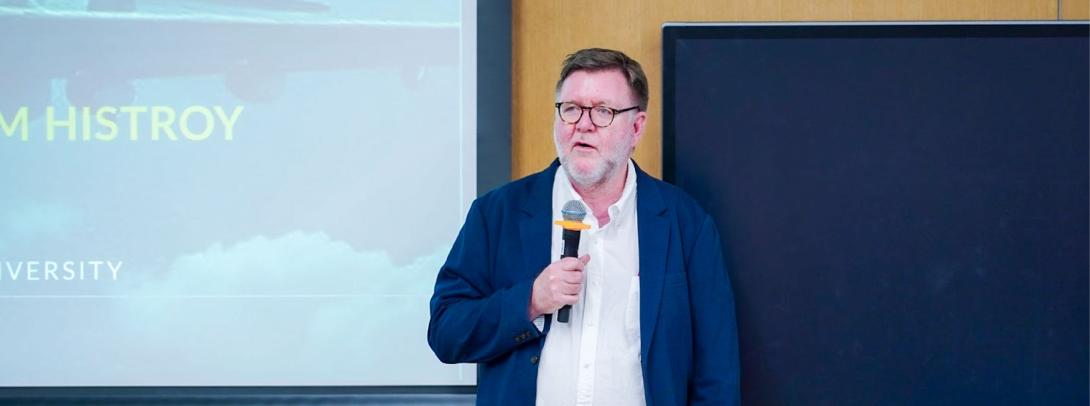
The world is not heading for a new Cold War, but is instead repeating the dangerous patterns of the early 20th century, risking a catastrophe on the scale of World War I. That was the stark warning delivered by renowned historian Odd Arne Westad, the Elihu Professor of History and Global Affairs at Yale University, during a lecture at NYU Shanghai on March 11.
Addressing the question "Why 2026 looks a lot like 1914?" and whether rising global tensions could lead to a major conflict, Westad’s talk drew from his latest book, The Coming Storm: Power, Conflict, and Warnings from History, to offer a sobering assessment of today’s geopolitical landscape. Nearly 100 participants from the NYU Shanghai community and East China Normal University (ECNU) attended the event in person and online. Co-hosted by the NYU Shanghai-ECNU Center on Global History, Economy and Culture and the Academy of History and Documentation of Socialism, the session was moderated by Research Professor Chen Zhihong, with commentary from Director of NYU Shanghai-ECNU Center on Global History, Economy and Culture and Professor of History Chen Jian.
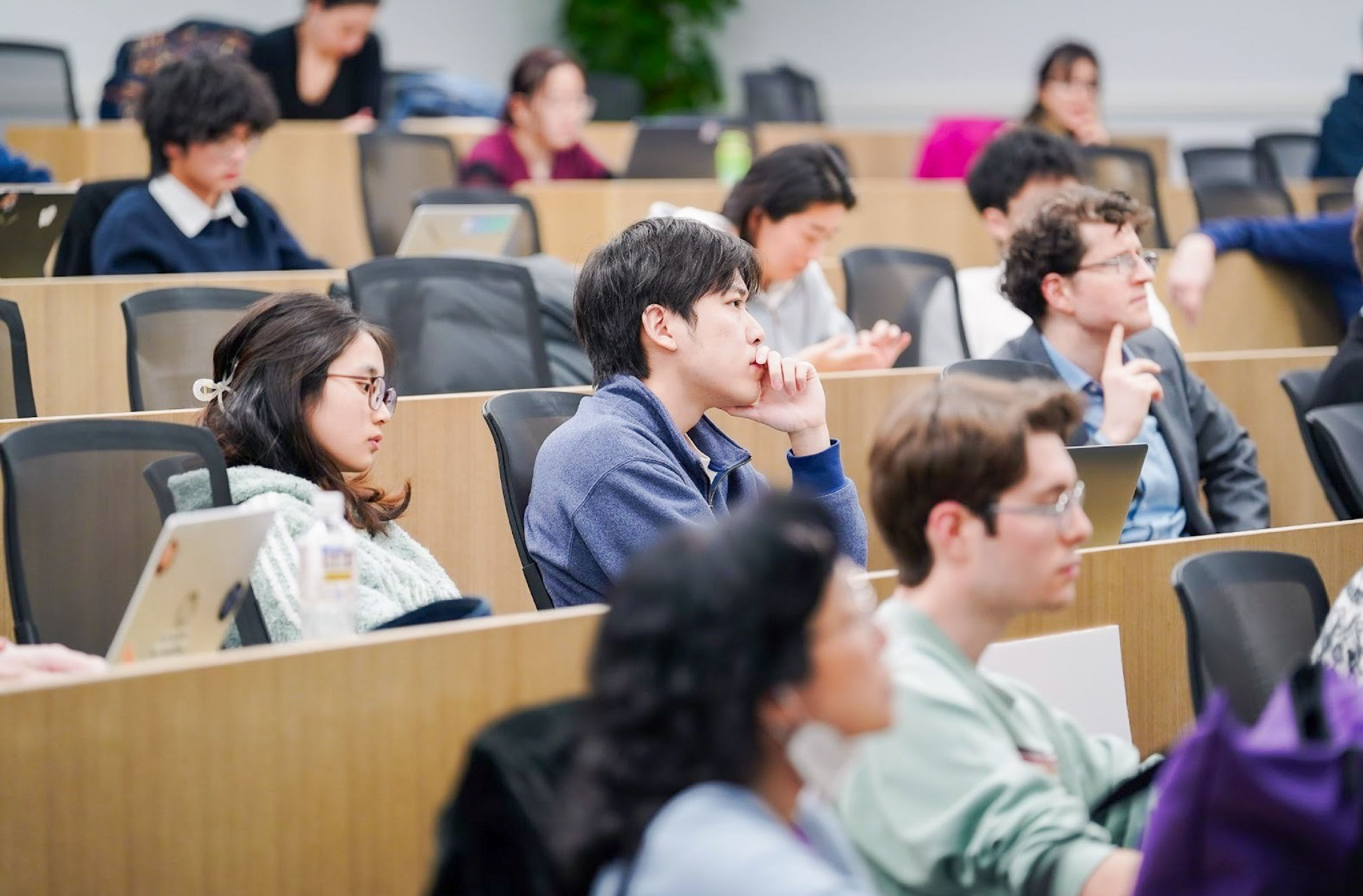
Drawing on decades of research on the Cold War and international history, Westad argued that the current global system increasingly resembles the international environment of the late nineteenth century to 1914. During that earlier period, rising powers challenged established ones, new technologies reshaped warfare and communication, and global economic integration generated both prosperity and resentment. According to Westad, similar structural forces are visible today. The international system is becoming increasingly multipolar, with several major powers competing for influence. Meanwhile, rapid technological developments—from artificial intelligence to advanced weapons systems—are transforming economies and security dynamics. At the same time, shifts in global markets and domestic political pressures have fueled skepticism toward globalization in many countries.
These conditions, Westad suggested, create a volatile environment in which regional conflicts can easily escalate. He pointed to ongoing tensions in the Middle East, Taiwan, and the Korean Peninsula as potential flashpoints requiring careful diplomacy. Global challenges such as immigration and terrorism further complicate cooperation among states. Despite these parallels, Westad stressed that history does not just automatically repeat itself. Unlike the leaders of 1914, today’s policymakers possess knowledge of past catastrophes and have institutions such as the United Nations and extensive alliance networks to help manage crises. Westad also cautioned against interpreting current tensions through the familiar framework of the Cold War. While such comparisons may seem reassuring, they risk oversimplifying a far more complex global reality. “Using the wrong model might actually take us away from the things we desperately need to do,” he warned.
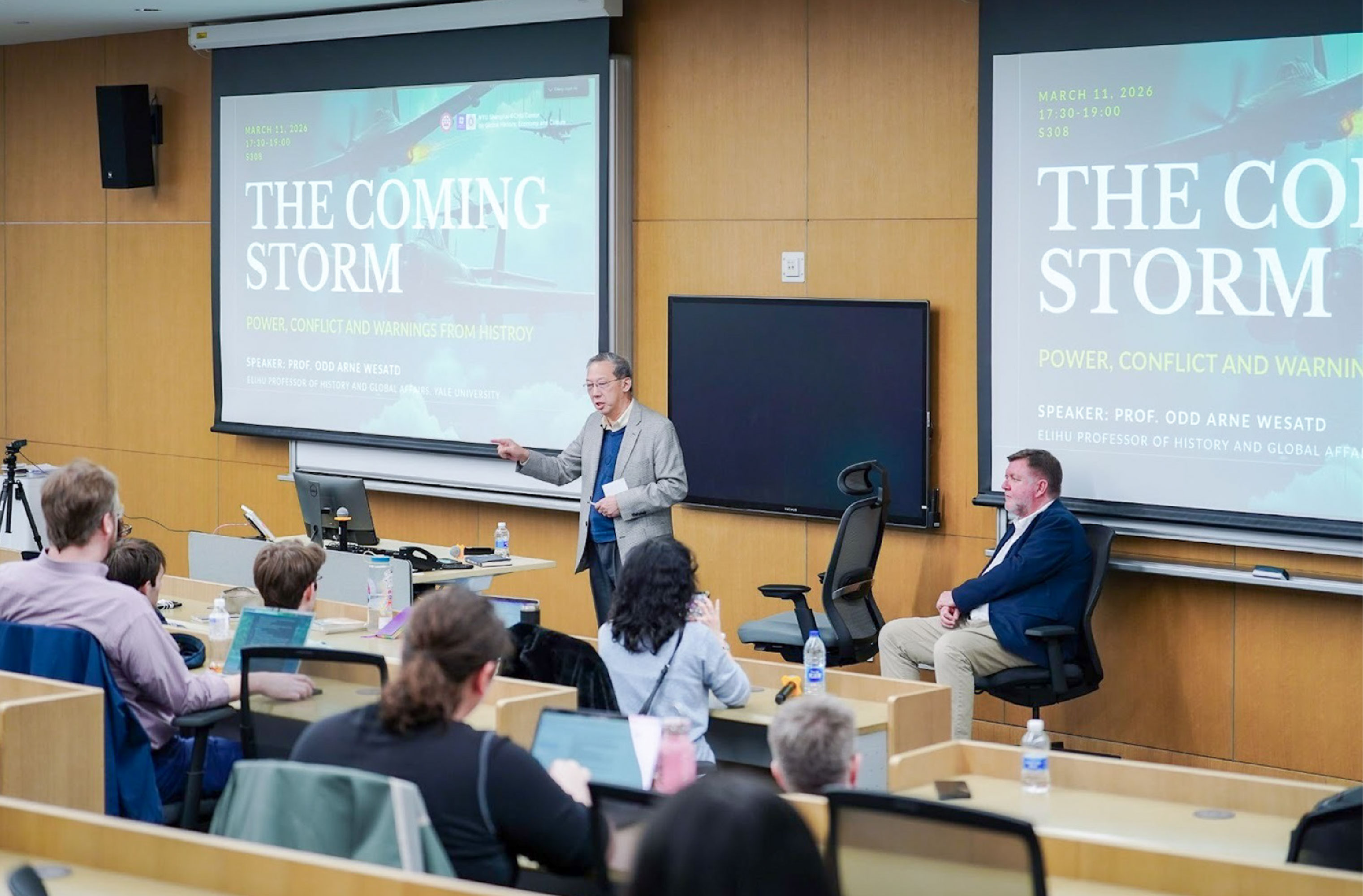
In his commentary, Professor Chen Jian underscored that the major challenges facing almost all countries today are those from within, not from without or in between. Audience members raised questions about nuclear deterrence, economic rivalry, and the principle of self-determination. The discussion concluded with a reminder that the past serves not only as a record of tragedy but also as a guide for avoiding it: structural tensions alone do not cause wars—human decisions do. Avoiding catastrophe, Westad argued, will require sustained dialogue among major powers, stronger multilateral institutions, and a willingness to learn from history. In an uncertain global environment, understanding the past may remain one of the most important tools for preserving peace.